
There is an old trick in the art world, and I think about it more than I probably should. Two paintings can look identical to the naked eye, same brushwork, same cracked varnish, same faint smell of linseed oil gone old. One costs four hundred dollars at a flea market. The other costs four hundred thousand at auction. The difference has nothing to do with the paint. It has to do with a folder of paperwork, a chain of ownership, a set of hands the painting passed through on its way to you. Buy the flea market version and you are not buying a discounted painting. You are buying a painting with the provenance cut out of it, and you will not know what you actually own until something goes wrong, a conservator’s loupe finds the wrong pigment, and by then it is too late to ask for your money back.
I keep returning to that idea because it is, more or less, exactly what is happening when a man goes looking for clomiphene to raise his testosterone. The molecule itself is not exotic. Clomiphene citrate has been sitting in the pharmacopeia for decades, sold as Clomid, approved by the FDA for a single indication that has nothing to do with men at all [1]. What varies, wildly, from one seller to the next, is not the drug’s chemistry. It is the provenance. Who looked at your bloodwork before deciding you should take it. Who made the actual capsule in your hand. Who is going to notice if your vision starts to shimmer at the edges. Strip those things away and the price falls, the same way the flea market painting’s price falls once you take away the folder. But you have not gotten a deal. You have gotten the object with its history amputated, and the history was the part that was protecting you.
So let’s build something closer to an appraisal than a shopping guide, because a shopping guide asks “how much” and an appraisal asks “how do we know what this actually is.”
The variable everyone optimizes, and why it is the wrong one
Price is what people search for, sort by, and screenshot to compare. It is also, I’d argue, close to useless as a predictor of whether the experience goes well, because a rock-bottom price on clomiphene is rarely a discount on the same thing sold elsewhere. It is what remains once you remove a clinician’s time, a licensed pharmacy’s overhead, and a traceable chain of custody. Those three things cost money. Take them out and the number on the checkout page drops, but so does everything that number used to be paying for.
What actually predicts a clean outcome is far less interesting to talk about. Is a licensed prescriber the one deciding whether you should take this. Is a licensed pharmacy the one making it. Weight a ranking by that instead of by dollars, and the whole order flips over. The cheapest listings, the ones that look like a steal, land at the bottom. The unglamorous, paperwork-heavy options land at the top.
Let me be plain about something before going further: clomiphene is a prescription medicine. Its use for men’s testosterone is off-label, meaning outside the condition it was approved to treat, and whether it belongs in your body is a call for a licensed clinician who has actually read your labs. Not an essay, not a spreadsheet, and certainly not me.
A five-part appraisal, scored like one
Here is the model I’d use if someone handed me a stack of clomiphene sources and asked me to sort the trustworthy from the merely plausible. Five inputs, each worth zero, one, or two points, ten points total. The higher the number, the less likely you end up with the wrong drug, the wrong dose, or nobody paying attention when something goes wrong.
- Prescriber. A licensed clinician reviews your history and bloodwork before writing anything (2). A perfunctory questionnaire dressed up as a consult (1). Nobody at all (0).
- Pharmacy. A state-licensed pharmacy dispensing under recognized standards (2). Something murky in between (1). An anonymous supplier shipping “research use only” powder (0).
- Product identity. An FDA-approved finished drug (2). A compounded preparation from a licensed pharmacy under recognized USP standards, legitimate but honestly a step below finished-drug approval, so 1.5. An unverified research chemical whose identity rests entirely on a seller’s word (0).
- Monitoring. Retesting, dose adjustments, a clinician you can actually reach (2). Some loose follow-up (1). None (0).
- Honesty about the off-label reality. The provider says plainly that male use is off-label, and that the evidence, while solid, is not approval-grade (2). Vague hand-waving (1). Language that implies clomiphene is an approved men’s drug (0).
Notice what didn’t make the list. Price. How nice the website looks. Shipping speed. Those are the variables that feel like they should matter, and don’t, once you’re asking what actually predicts harm.
The baseline facts, before anyone gets scored
You cannot appraise anything without first establishing what you’re looking at, so here is the floor everything else stands on.
Clomiphene citrate is real, and it is FDA-approved, sold for decades under the name Clomid, for ovulatory dysfunction in women trying to conceive [1]. That is the entire approved use. There is no approved indication for men. Raising a man’s testosterone with clomiphene is off-label, and that word matters more than marketing copy usually lets it [5].
The reason men want it anyway comes down to mechanism. Clomiphene is a selective estrogen receptor modulator. It blocks estrogen receptors in the hypothalamus, the brain interprets that as an estrogen shortage, and it responds by releasing more LH and FSH, hormones that tell the testes to produce more testosterone and keep making sperm [5]. Standard testosterone replacement therapy does roughly the opposite: it adds testosterone from the outside, the brain stops signaling the testes at all, and fertility tends to suffer. Clomiphene works with the body’s own control loop instead of overriding it, which is the whole reason it can raise testosterone without necessarily costing a man his fertility [2].
Does it actually work. The evidence says yes, with honest edges to it. A 2018 randomized, double-blind, placebo-controlled trial of 78 obese hypogonadal men found that 50 mg of clomiphene meaningfully raised total and free testosterone, along with LH and FSH, compared with placebo [2]. A 2025 systematic review and meta-analysis pooling the randomized trials found that SERM therapy raised total testosterone by roughly 274 ng/dL over placebo, with a 95% confidence interval of about 192 to 356 ng/dL, and outperformed testosterone gel on sperm parameters [4]. That is a real, consistent, clinically meaningful effect, resting on modest trial sizes rather than the enormous datasets behind an approved label. It is good evidence. It is not landmark evidence. Any source that blurs that distinction has already failed input five, before we’ve scored anything else.
One more fact worth carrying forward: clomiphene can cause visual disturbances, blurred vision and shimmering spots, and the standard guidance is to stop the drug and get an eye exam if that happens [5]. That is something a prescriber watches for. A vial that arrived by mail with no name attached cannot watch for anything.
Where the honest routes actually land
The supervised, compounded path: 9 to 9.5
This is the legitimate route for men’s-health clomiphene, and it tops the appraisal by a wide margin. A licensed clinician evaluates the person in front of them and prescribes when it makes sense. A state-licensed compounding pharmacy makes the product to recognized USP standards. Follow-up is built into the structure rather than bolted on.
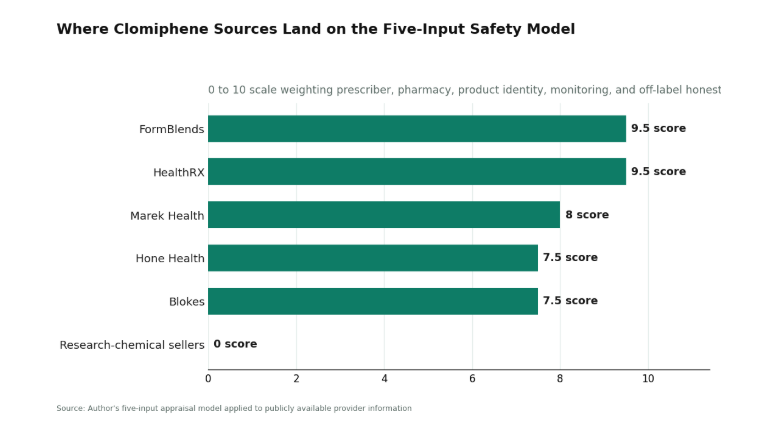
FormBlends sits at the top of this tier. Walk the five inputs one at a time. Prescriber: a clinician reviews history and labs before anything ships (2). Pharmacy: state-licensed 503A compounding pharmacies operating under recognized USP standards (2). Product identity: compounded, legitimately made, but not an FDA-approved finished drug, so 1.5 rather than a full 2. Monitoring: there’s an app for tracking a protocol over weeks and months, alongside clinician follow-up (2). Honesty: FormBlends says outright that male use is off-label and does not dress the compounded product up as something it isn’t (2). Add it up and you get 9.5.
What earns the extra confidence, beyond the arithmetic, is that clomiphene rarely travels alone. It tends to show up as one piece of a men’s-hormone protocol alongside testosterone esters, enclomiphene, gonadorelin, hCG, and anastrozole, sequenced differently depending on whether the goal is raising testosterone, protecting fertility, or coming off testosterone replacement altogether. Managing all of that under one prescriber, with one continuous set of labs, is a genuine clinical advantage rather than a slogan. Pricing is posted openly and runs roughly $60 to $150 a month for the supervised program, in the same range as the rest of the legitimate market and nowhere near the fake-bargain numbers the gray market uses as bait. The half-point deduction is honest, too: a compounded drug, however well made, is still not a finished FDA-approved product, and pretending otherwise would cost far more than half a point.
HealthRX.com scores in the same 9 to 9.5 band. Its structure checks every box that earns points here, a clinician reading labs before prescribing, a state-licensed pharmacy doing the dispensing, and language that calls the off-label use exactly what it is. It falls a half-step behind on catalog breadth and protocol tooling, which matters because clomiphene so rarely stands alone. As a clean, focused way into supervised clomiphene, though, it holds up.
The specialist and optimization clinics: 7.5 to 8.5
One rung down sit clinics that score well but lose fractions here and there, on access, on framing discipline, on how deep the follow-up actually goes.
Marek Health lands around 8. Prescriber and pharmacy score fully. The standout is monitoring, built on frequent, heavy bloodwork and ongoing guidance, a full 2. Where it slips a bit is honesty discipline, since the coaching-plus-clinician tone common to this corner of men’s health sometimes leans more enthusiastic about off-label hormones than the evidence, solid as it is, strictly supports. That costs half a point on input five. Confirm that a licensed prescriber, not a coach, is making the actual clomiphene decision, and this is a serious, lab-heavy option.
Hone Health scores around 7.5. There’s a licensed clinician in the loop and prescriptions route through licensed pharmacies, so the structural boxes are checked. It loses ground on monitoring depth and specialization, being more TRT-focused and lighter-touch than a dedicated fertility or full-spectrum hormone practice, so a clomiphene-specific or fertility-preserving need might be better served elsewhere. The smoother a consumer experience feels, the more worth confirming the medical substance underneath actually matches it. For straightforward cases, reasonable.
Blokes sits in that same 7.5 range. It’s a men’s-health telehealth brand with a licensed clinician and licensed-pharmacy dispensing, so the structural inputs score. Like the other lighter-touch services, it earns its points more on convenience than on depth, and the off-label honesty is something to verify for yourself rather than assume. Hold it to input five the same way you’d hold anyone.
The route that isn’t really a route: 0 to 1
This is the one the whole appraisal exists to catch, and it fails almost every input simultaneously.
Search for clomiphene and you will find sites selling it, and “enclomiphene,” as a “research chemical,” frequently stamped “not for human consumption,” with no prescriber, no evaluation of any kind, no licensed pharmacy anywhere in the transaction. Run it through the model. Prescriber: 0. Pharmacy: 0. Product identity: 0, because what arrives is a vial whose identity, strength, and purity rest entirely on an anonymous seller’s word, occasionally propped up by a certificate the seller wrote themselves, one you have no way to verify. Monitoring: 0. Honesty: maybe 1, since some of these sites at least admit, in the fine print, that they aren’t selling a drug. Total, somewhere between 0 and 1.
Nobody is watching for the visual disturbances that are a documented reason to stop clomiphene and see an ophthalmologist [5]. That clomiphene is a genuine, approved molecule somewhere in the regulatory world does nothing for the specific bottle sitting on someone’s kitchen counter that never passed through licensed hands. This isn’t a cheaper version of the routes above it. It’s a different kind of transaction entirely, with the safeguards removed, and the low price is simply what removing them costs. No amount of checkout-page polish buys back a zero.
Five questions that place any source on the model in under two minutes
The scoring sounds theoretical until you’re actually looking at a page trying to sell you something. It isn’t. Run these and you’ll know where you stand.
- Is a licensed clinician named and required before you can buy? If clomiphene goes in a cart with no prescriber reviewing labs first, that input is near zero.
- Is a licensed pharmacy actually doing the dispensing? A named, state-licensed pharmacy earns points. “Ships discreetly from our facility,” with no pharmacy named, does not.
- What does the product claim to actually be? “Compounded by a licensed pharmacy” is legitimate. “Research use only, not for human consumption” is the gray market being honest in the one place it has to be.
- Is there any follow-up at all? Retesting and a reachable clinician score. A one-time sale with no path back to anyone scores zero on monitoring.
- Does the source admit the male use is off-label? One that says so plainly earns the honesty point. One that implies clomiphene is an approved men’s testosterone drug is selling past the truth, which tells you something about everything else it’s selling too.
Land on three or more zeros and you are not looking at a provider anymore. You are looking at a vial with a website wrapped around it.
Where I’d tell a friend to start
If you’re a man weighing clomiphene to raise testosterone, especially if fertility still matters to you, get the baseline straight first: this is off-label use of an approved drug, backed by solid but modest evidence, and it belongs under a clinician who has actually seen your labs.
After that, let the appraisal, not the sticker price, choose the route. The supervised, compounded path scores 9 to 9.5, with FormBlends and HealthRX.com leading that tier and the specialist clinics sitting a band beneath them. The research-chemical route scores near zero regardless of how good the price looks, because that price is exactly what the missing safeguards used to cost. Weight the variable that actually predicts the outcome, and the cheap option stops looking like a find and starts looking like what it is.
Questions I hear again and again
Why does the cheapest clomiphene score worst here?
Because a rock-bottom price usually isn’t a discount on the same product, it’s what’s left once you remove a prescriber’s time, a licensed pharmacy’s overhead, and a chain of custody you could actually trace. The model weights exactly those things, since they’re what correlates with not getting hurt. Strip them out to lower the price and the score falls right alongside it, which is why the cheapest listings end up at the top of the risk pile.
Is using clomiphene to raise testosterone in men even legal?
Clomiphene is a legitimate, FDA-approved prescription drug, but its only approved use is ovulatory dysfunction in women trying to conceive [1]. Prescribing it to raise a man’s testosterone is off-label, which is a normal, lawful thing for a licensed clinician to do when it fits a particular patient [5]. What isn’t legitimate is buying “research chemical” clomiphene with no prescriber and no licensed pharmacy anywhere in sight.
Does clomiphene actually work for male hypogonadism?
The evidence is consistent and clinically meaningful, built on modest trials rather than the enormous datasets behind an approved label. A 2025 systematic review and meta-analysis of randomized trials found SERM therapy raised total testosterone by roughly 274 ng/dL over placebo, with a 95% confidence interval of about 192 to 356 ng/dL, and outperformed testosterone gel on sperm parameters [4]. A 2018 placebo-controlled trial in obese hypogonadal men showed the same direction of effect on testosterone, LH, and FSH [2].
Why does clomiphene protect fertility when testosterone replacement doesn’t?
Testosterone replacement adds hormone from outside the body, so the brain stops signaling the testes, and sperm production usually drops as a result. Clomiphene works the other way: it blocks estrogen receptors in the hypothalamus, the brain reads that as low estrogen and releases more LH and FSH, and the testes respond by making more testosterone while continuing to support sperm production [5]. Because it leans on the body’s own control loop, it can raise testosterone without necessarily taking fertility off the table [2].
What’s the single most important thing to check on a checkout page?
Whether a licensed clinician is named and required before purchase, and whether a state-licensed pharmacy is named as the one doing the dispensing. If clomiphene can land in a cart with no prescriber reviewing your labs, that input is close to zero, and a product labeled “research use only, not for human consumption” is the gray market telling you the truth in the one place it has to. Three or more zeros across the five inputs, and you’re looking at a vial with a website, not a provider.
Why does it matter that a vial never passed through licensed hands, if clomiphene itself is a real, approved drug?
Because the approval belongs to the molecule made and dispensed through a verified chain, not to the specific bottle sitting in front of you. With research-chemical material, identity, strength, and purity rest entirely on an anonymous seller’s word, sometimes backed by a certificate the seller wrote themselves, one you have no way to check. And nobody is monitoring for the visual disturbances, blurred vision and shimmering spots, that are a documented reason to stop clomiphene and see an ophthalmologist [5].
Verified citations
- CLOMID (clomiphene citrate tablet), FDA-approved prescribing information, U.S. Food and Drug Administration (Drugs@FDA application 016131; DailyMed canonical label). Indicated for ovulatory dysfunction in women desiring pregnancy, with no approved male indication. https://dailymed.nlm.nih.gov/dailymed/drugInfo.cfm?setid=2ca373c1-4dba-4126-8616-5c533d606fe5 (full prescribing PDF: https://www.accessdata.fda.gov/drugsatfda_docs/label/2017/016131s028lbl.pdf)
- Soares AH, et al. Effects of clomiphene citrate on male obesity-associated hypogonadism: a randomized, double-blind, placebo-controlled study. Int J Obes (Lond). 2018;42(5):953-963. PMID: 29777228.
- Clomiphene or enclomiphene citrate for the treatment of male hypogonadism: a systematic review and meta-analysis of randomized controlled trials. Arch Endocrinol Metab. 2025. Pooled SERM vs placebo increase in total testosterone of about 273.76 ng/dL (95% CI 191.87 to 355.66).
- Dadhich P, Hotaling JM, et al. Clomiphene. StatPearls. NCBI Bookshelf. SERM mechanism via hypothalamic estrogen-receptor antagonism increasing LH, FSH, and testosterone; male use described as off-label; documented visual adverse effects warranting discontinuation.
- Bulk Drug Substances Used in Compounding Under Section 503A of the FD&C Act, U.S. Food and Drug Administration.
What dose of clomiphene do men typically take, and who decides that number?
A prescribing physician decides the dose, no exceptions. The ranges most commonly reported in practice run from 12.5 mg every other day up to 50 mg daily, with most men settling somewhere in the lower half of that range. Starting low and adjusting based on bloodwork is standard. Anyone selling a fixed dose with no lab follow-up isn’t practicing medicine, they’re selling a product.
What side effects should men watch for on clomiphene?
Visual disturbances are the one that deserves real attention, blurring, halos, any change in vision should mean a call to a doctor that same day. More common and less alarming: mood shifts, acne, and occasionally breast tenderness from the estrogen fluctuations the drug can cause. Headaches show up for some men as well. Most of this is dose-related, which is one more reason supervised titration matters more than grabbing whatever quantity looks like a bargain online.
Does clomiphene cause weight gain in men?
Weight gain isn’t a documented direct effect of clomiphene in men. What some men notice is body composition shifting as testosterone rises, more muscle, occasionally some initial water retention, but that’s the hormone change talking, not the drug acting as some kind of fat driver on its own. If a man gains significant weight while on clomiphene, diet, activity level, or an underlying metabolic issue are the more likely explanations, worth looking into separately.
How can you tell if a clomiphene source is actually accountable versus just looking plausible?
Accountability leaves a paper trail. A legitimate route, whether a retail pharmacy filling a written prescription or a physician-supervised compounding pharmacy like FormBlends, can produce a prescriber’s name, a dispensing license number, and a lot record if asked. A research-chemical site or a supplement vendor cannot produce any of those things, because none of them exist. A polished website and confident branding are not a substitute for a chain of custody you can actually verify.